
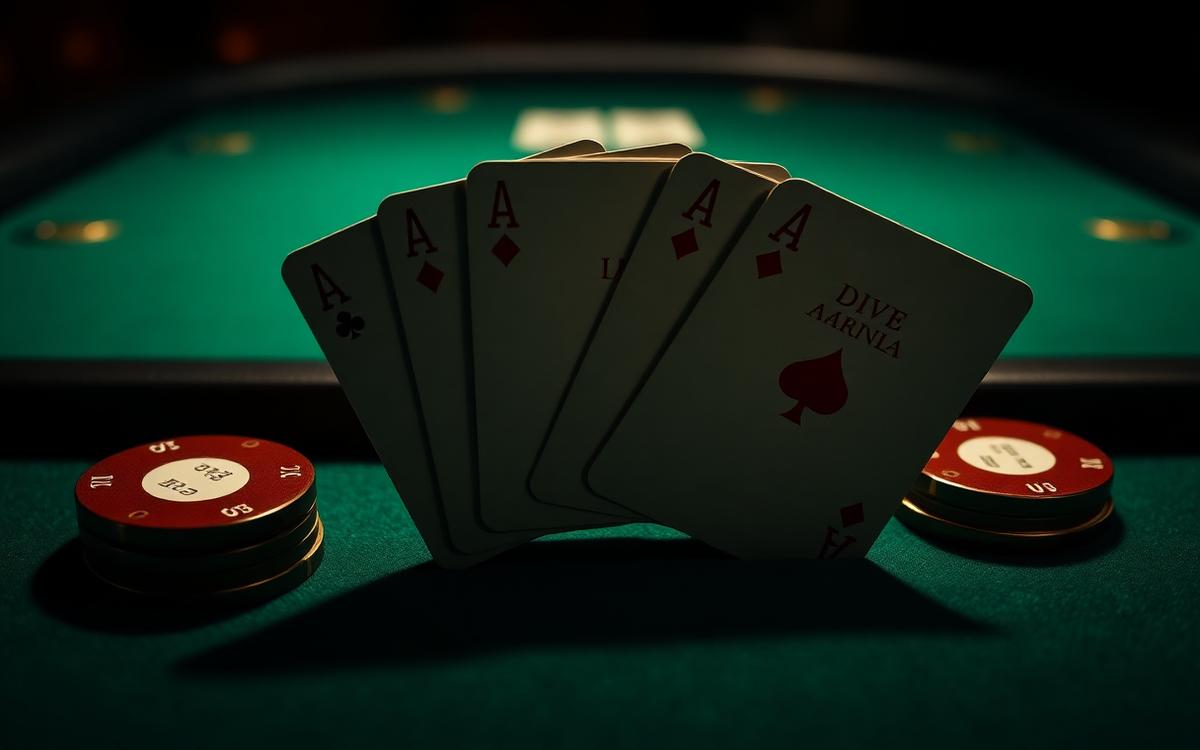
What Chinese poker is
Chinese poker is a card game where each player arranges thirteen cards into three separate poker hands and scores them against every opponent hand-for-hand. There is no betting on streets and no folding: everyone reaches showdown every time. The skill is entirely in how you split your cards, which makes it a very different discipline from Hold'em despite using the same hand rankings.
The three rows and the one unbreakable rule
You build a back hand of five cards, a middle hand of five cards, and a front hand of three cards. The back must be the strongest, the middle next, and the front the weakest. If your rows are out of order the hand is fouled and you lose to every opponent on all three rows — the single most costly error in the game. In the front row of three cards, only pairs, high card and three of a kind exist; straights and flushes cannot be made with three cards.
Scoring, units and scoops
Each row is compared separately against each opponent and pays one unit. Winning two rows and losing one nets you one unit; winning all three is a scoop and typically pays a bonus. In a four-handed game you settle against all three opponents simultaneously, which means a single fouled hand can cost nine units or more in one deal. This scoring structure is why safe, legal arrangements almost always beat greedy ones.
Open-face Chinese and Pineapple
Open-face Chinese (OFC) is the variant most people now play. You receive five cards to start, place them, and then draw cards one at a time, placing each irrevocably before seeing the next. Pineapple OFC deals three at a time, of which you place two and discard one — faster and higher-variance. In OFC, Fantasyland is the standing reward: making a qualifying front hand (commonly queens or better) lets you receive your entire next hand at once and arrange it with full information.
Royalties and why they change the strategy
Bonus points, called royalties, are awarded for strong holdings in each row — larger in the front and middle than in the back, because they are harder there. Royalties are the reason players deliberately take fouling risk: a strong middle hand may be worth more than the safe arrangement it replaces. Learn the royalty table for the exact game you are playing before adjusting your risk, as scales differ between home games and apps.
Practical strategy for a new player
The base rules are simple; discipline is what separates results.
- Set your back row first and work forward — never build the front before you know the back is safe
- When in doubt, take the safe arrangement: a foul costs more than a missed royalty gains
- In OFC, count your outs before placing early cards, because placement is irreversible
- Chase Fantasyland only when the front pair is already close and the back is secure
- Track what has been placed face-up around the table — those cards are gone from your draws
Where it fits alongside Hold'em
Chinese poker sharpens hand-reading and combinatorics because you are constantly counting which cards remain. It does not train betting, position or bluffing at all, so it complements rather than replaces Hold'em study. The shared foundation is hand rankings — /en/poker-hands — and the counting habit transfers directly to outs and equity work in /en/poker-outs.
Want to join the Israeli club?
Get personal onboarding in English — from download to the table. Fast and clear.